Moulin Rouge (2001) Directed by Baz Luhrmann
Detail how setting is used in creating meaning and understanding in a film.

The opening scene of Moulin Rouge depicts a red theater curtain which opens to a black and white scene of Paris in ruin. This infers that the story about to be shown is as if it's a theater production, which is a key theme throughout the film. As the shot moves through Paris, it goes to a room showing the protagonist, Christian (played by Ewan Mcgregor) with his head in his arms in very low key lighting, surrounded by empty bottles, dust and dirt. This shows his dispare and the fact that he's surrounded by darkness could reflect his lack of hope. This gives the viewer a obvious understanding that a tragic event has previously taken place, which is later explain that the death of his lover, Satine, had caused his pain. The film then flicks from scenes of a derelict Paris to a vibrant, ornamented and bohemian club, The Moulin Rouge. It also shows a very clean-cut and tidy Christian, further showing his emotional deterioration after Satine's death. This shows that even though Paris is in ruin, there's still a fun and colourful place in which people can come and relax in true Bohemian style. This is where the clear and recurring theme of black and red becomes evidant. Even though the world is cloaked in black despair, the luminous red of the Moulin Rouge provides hope.

A very important scene in the film is when Christian and Satine (played by Nicole Kidman) first met. Their meeting location is inside a large, highly ornamented elephant located just outside of the Moulin Rouge. The fact that the location is so extraordinary displays the crazed ideas of the people in those situations. The elephant is also a large animal, this could show how the Moulin Rouge are trying to boost their status within the world at the time, however it's later apparent that they're just as deprived as every other person. The elephant also has a big, heart-shaped opening at the front, displaying how their love is very open and public, which is late contrasted by the factor that they have to hide it. As the couple duet together, it switches to a scene above Paris, where they both dance together in the clouds, showing how their love for each other makes them feel on top of the world. It could also say that by them being in the clouds, the plaintive scenes of Paris and behind them, which is only the case when they're together.

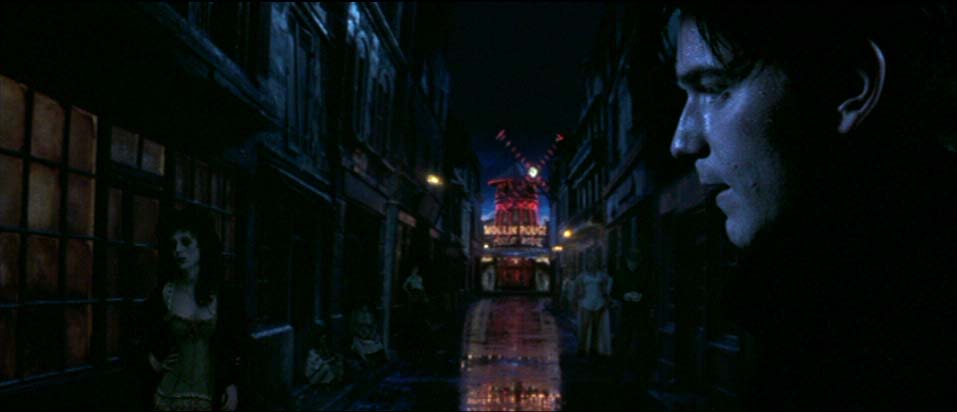
As the show 'Spectacular Spectacular' in which Christian is writing and Satine is staring in begins, it's clear that each event within the play, also takes place within the film. In the play, the courtesan. played by Satine, has to convince her lover that she doesn't love him, Which is exactly what Satine does in the reality as she's told repeated by Harold Ziddler that she had to be with the Duke, for the sake of his money, which is a massive contrast to the Bohemian belief of "Freedom, Beauty, Truth and Love" which is repeated throughout the film. After being left, Christian decides to visit the Moulin Rouge one last time. This is when we see a scene of a dark, ruined street, but in the center is the Moulin Rouge, lavished with red and appears as the light at the end of the tunnel - however, that is the main contradiction. The Moulin Rouge advises itself to be the home of the Bohemian revolution and it's belief in love, but was easily persuaded by the Duke's money. This is when the hypocrisy of the building and it's belief becomes the most apparent, and how the entire building is merely a cloak, a lie and a red curtain to the truth; The Moulin Rouge is just as derelict and desperate as every other building in Paris. It's also depicted as if it's the light at the end of the tunnel, however it's also the very thing that causes Christian's emotional pain the viewer witnessed in the opening scenes, and currently seen in the fact that he's stood in the darkness.

The closing scenes of the film show the ending of the play, and how Christian becomes part of the play and him and Satine sing their lovers song, declaring their love for each other. Christian asserts his role in the play because it's links so heavily with his reality, coinciding with the theater theme. As the finale of the play has finished and the ending from the audience in the theater's point of view is happy and love driven, the curtain closes. As the curtain is down, Satine collapses, and thus the dark stab of reality seeps through, Satine is dying and although the audience on the other side of the curtain are still applauding for love, on the other side of the curtain is despair as love is shattered by reality. This could mean that although they tried to depict their lives as a play, reality will always take over, which would always ruin the Bohemian belief. Christian and Satine are both seen in dark lighting. As Satine lie collapsed on the floor in Christian's arms she's in the darkness of his shadow as he cries, displaying that the shadow of his despair has consumed her, and even though the applause and the red of hope is all around them, dark reality has taken over, again.
 The protagonist, Wesley, at the beginning is depicted as a very anxious and nervous character. With medication to settle his constant panic attacks, his body language is also a clear indicator of his neurosis. Wesley is often slouched and looking down at the floor, this shows that he has problems with maintaining eye contact and interacting with other people. He's also has very closed body language to replicate his feel of being trapped in his own body. His facial expression is often quite blank and inexpressive which could show how due to his anxiety, he's very overconscientious of his own life to pay attention to situations around him.
  When Wesley meets Fox, the first action scene of the film takes place and it's then that the viewer sees Wesley pure state of panic to loud noises and his surroundings, something that dramatically changes towards the end of the film. Wesley has his head in his hand, trying to protect himself whilst being flung around the supermarket. His body language is still extremely closed and he's in a pure state of panic. But it's after that moment that Wesley realizes, he doesn't want to be trapped in the nervous prison of his body anymore, he wants to change.